 listicle
Best Craft Supplies for Home Decor: 2026 Picks
Table of Contents
- Essential Craft Tools for Beginners: Your Starter Kit
- Best Adhesives for DIY Home Decor Projects
- Top Wood Cutouts and Fabric for Home Decor Crafts
- Complete DIY Craft Kits for Home Decor
- Craft Supply Organization Tips for a Tidy Workspace
- Eco-Friendly and Budget-Friendly Craft Supplies
- How to Maintain and Care for Your Craft Tools
- Conclusion
- Frequently Asked Questions
Last Updated: September 21, 2026
Essential Craft Tools for Beginners: Your Starter Kit
The best craft supplies for home decor start with a short list of tools you will actually reuse: a hot glue gun, a rotary cutter, a precision knife, a cutting mat, sanding blocks, and a small set of detail brushes. This guide walks through every category that matters, from adhesives to storage, so you can build a workspace that grows with your projects instead of fighting it.
Beginners often buy too much of the wrong thing. A common mistake is loading up on specialty gadgets before owning a decent cutting mat or a reliable pair of scissors. Start with multi-purpose tools, then add the niche items as specific projects demand them.
Craft supplies is a broad term, so here is a working definition: craft supplies are the consumable materials and reusable tools used to cut, join, paint, and finish handmade items. For home decor, that means adhesives, cutting tools, paints, fasteners, and the base materials you decorate.
| Tool | Typical Use | Beginner Priority |
|---|---|---|
| Hot glue gun | Fast bonding on wood, fabric, faux greenery | High |
| Rotary cutter + mat | Straight cuts on fabric and paper | High |
| Precision knife | Detail trimming, stencil work | High |
| Sanding block | Surface preparation before paint | Medium |
| Detail brushes | Small accents, tight corners | Medium |
Best Adhesives for DIY Home Decor Projects
The right adhesive depends on what you are bonding, not on brand loyalty. A wreath bow and a floating shelf bracket are not the same problem.
- Porous to porous (wood, paper, fabric, unfinished cutouts): hot glue, tacky glue, or wood glue all work. Hot glue wins on speed, wood glue wins on strength.
- Porous to non-porous (wood to glass, fabric to ceramic): you need a flexible adhesive that can handle slight movement, such as a clear-drying craft glue or a silicone-based adhesive. Rigid glues crack when the two materials expand at different rates.
- Non-porous to non-porous (glass to metal, tile to plastic): hot glue will pop off. Use a strong craft adhesive or an epoxy rated for the materials listed on the package.
- Anything that gets warm (above a fireplace, near a window, on a sun-facing shelf): skip hot glue entirely. It softens around the temperature of a hot car interior and lets go.
Open time vs. cure time. Open time is how long you have to reposition the piece before the glue grabs. Cure time is how long before the joint reaches full strength. Hot glue has an open time measured in seconds and a cure time measured in minutes. Wood glue gives you several minutes of open time but needs a full day to cure at room temperature. Plan your project around the slower number, not the faster one.
A practical three-glue kit.
| Adhesive | Best For | Watch Out For |
|---|---|---|
| Hot glue gun | Faux greenery, ribbon, quick mockups | Heat, and stringy residue on visible surfaces |
| Wood glue | Load-bearing wood-to-wood joins, furniture repair | Needs clamping and a full cure |
| Clear-drying craft glue | Beads, buttons, paper, mixed materials | Slow grab; parts slide unless supported |
Surface prep matters more than the glue. Wipe glass and ceramic with rubbing alcohol and let it dry. Sand glossy wood or painted surfaces lightly so the adhesive has something to bite into. On unfinished wood cutouts, peel the protective paper backing first, because paint and glue will not adhere properly over it.

A note on removability. If you might redecorate in a year, choose a removable adhesive for wall-mounted decor and save the permanent stuff for pieces you intend to keep. Command-style strips and removable putties are designed for this; wood glue and epoxy are not.
Keep at least three adhesives on hand, matched to your three most common surface pairs, and you will rarely be stuck mid-project.
Top Wood Cutouts and Fabric for Home Decor Crafts
Unfinished wood cutouts are the fastest route from blank surface to finished decor. Teecraftsmarket carries a cabinet-grade Baltic birch sunflower cutout in sizes from 1" to 36", lightly sanded and ready for acrylic paint, stain, or resin. The rustic wagon wheel shape, available from 3" to 24", suits wreath making and farmhouse wall art.

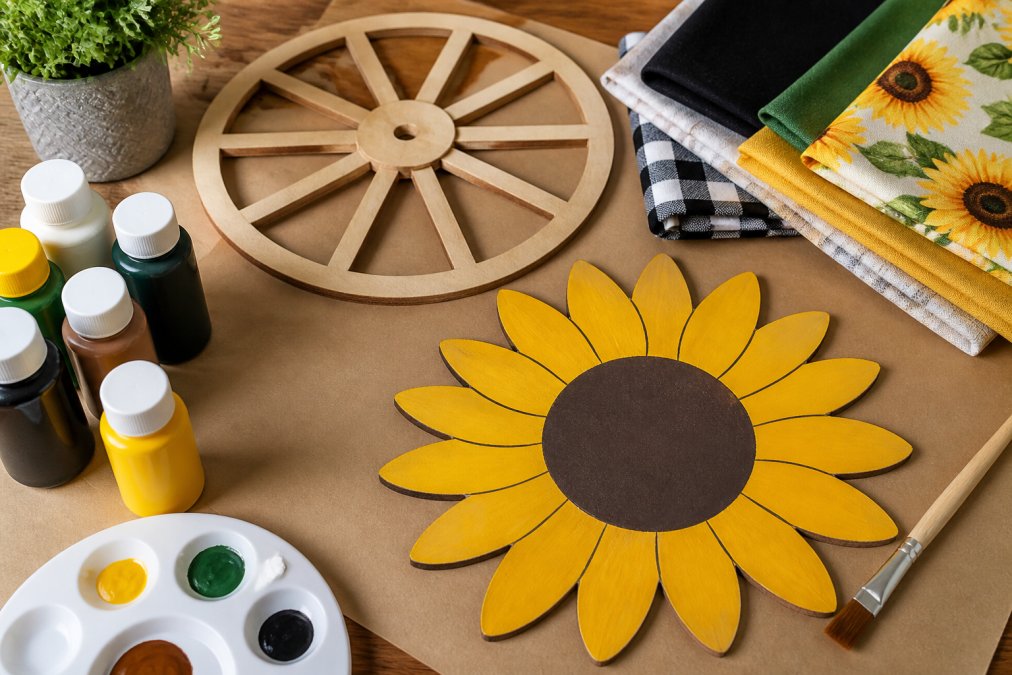
Fabric rounds out the category. Quilting-weight cotton, like the Poppie Cotton collections sold by the yard, works for pillows, banners, and table runners. Pair a floral print with a neutral solid and the project looks intentional without extra effort.
For beginners, a wood cutout plus one fabric accent covers most starter projects.
Complete DIY Craft Kits for Home Decor
Kits remove the guesswork. A macrame leaf and feather kit arrives with pre-cut cotton cord, a wooden ring or dowel, and a printed or digital pattern with photos for every step. For fall decor, a crochet pumpkin pattern uses recycled silk yarn and finishes at roughly 3" tall.
Diamond art kits suit anyone who wants a finished wall piece without cutting or gluing. The 5D aurora landscape kit includes resin rhinestones, an applicator pen, a tray, wax, and color-coded instructions.

Craft Supply Organization Tips for a Tidy Workspace
Most organization advice assumes you have a craft room. If you are working from a closet, a rolling cart, or one corner of a shared apartment, the rules change. The goal shifts from "store everything" to "store only what earns its footprint, and make setup and teardown fast enough that you actually start projects."
Start with a footprint audit. Before buying a single bin, lay every supply on the floor and sort into three piles: used in the last month, used in the last year, and never used. The never-used pile is the one that eats your space. Donate or repurpose it.
Organize by task, not by type. A cutting station, a painting station, and an assembly station each hold the tools that belong to that step.
A small-space starter checklist:
- Sort everything into cut, join, paint, and finish categories
- Move daily-use tools into a caddy or cart you can carry to the table
- Store fabric flat or rolled, never folded tight, to avoid creases
- Label bins by project type, not by product name
- Keep a small "scrap" bin for offcuts instead of tossing them
- Use wall or door space before you buy another floor bin
- Set a one-in, one-out rule for tools you rarely use
Eco-Friendly and Budget-Friendly Craft Supplies
Eco-friendly choices can be a great value over time. Recycled silk yarn, cotton macrame cord, and unfinished wood cutouts offer alternatives to plastic-heavy kits. Buying a plain wood shape and finishing it yourself can be a rewarding experience.
How to Maintain and Care for Your Craft Tools
Tool care is an important step. Clean glue gun nozzles while they are still warm, wiping away stringy residue before it hardens. Wipe paint brushes with the correct solvent and reshape the bristles by hand before drying them flat.
Conclusion
Building a home decor craft stash is less about buying everything at once and more about choosing tools you will reach for again. Start with the essentials, add kits to test new crafts, and maintain what you own so it lasts.
Frequently Asked Questions
What are the essential craft supplies to have at home for decor projects?
Start with a basic toolkit: a hot glue gun and tacky glue, a rotary cutter with a cutting mat, precision knife, scissors, acrylic paint set with detail brushes, sanding block, and a variety of fasteners. For home decor specifically, add unfinished wood cutouts, fabric panels, and embellishments like faux greenery. These essentials cover most DIY projects, from wreath making to painted wall art. Keep everything in a craft closet or storage bins so you can find supplies quickly.
What are the best adhesives for DIY home decor?
The right adhesive depends on your materials. For wood and general crafts, tacky glue and wood glue create strong bonds. A hot glue gun works fast for attaching embellishments, faux greenery, and fabric to wreaths. Mod Podge is ideal for decoupage and sealing painted surfaces. For fabric projects, use fabric glue or a sewing machine. Always test on a scrap piece first, and remember that surface preparation, like sanding and cleaning, helps adhesives hold better.
How do I choose high-quality craft supplies for long-lasting decor?
Look for materials that match your project's demands. Cabinet-grade Baltic birch plywood, like the sunflower and wagon wheel cutouts, holds paint and stain well. For fabric, 100% cotton in a 43/44-inch width is durable for quilting and home decor. Check that adhesives are appropriate for the surface, and choose multi-purpose tools with comfortable grips. Quality supplies may cost a bit more upfront, but they last longer and produce professional-looking results.
What tools are necessary for beginners starting home decor crafts?
Beginners need a few core tools: a hot glue gun, tacky glue, scissors, a rotary cutter with a cutting mat, a precision knife, acrylic paint and brushes, and a sanding block. A small hammer and assorted fasteners help with assembly. Start with beginner-friendly kits, like the macrame leaf kit or crochet pumpkin pattern, which include pre-cut materials and step-by-step instructions. As you gain confidence, add specialized tools for wood burning, stenciling, or sewing.
Teecraftsmarket curates the supplies that make this easier: cabinet-grade birch wood cutouts, quilting cotton by the yard, beginner-friendly macrame and diamond art kits, and the small tools that hold a project together. Every piece is chosen for real-world utility, and our wood shapes are printed and cut right here in the United States. Get started with Teecraftsmarket and build a workspace that keeps up with your next project.