 blog
blog
Best Plain Tees for Graphic Design: 2026 Guide
Table of Contents
- Best Plain Tees for Graphic Design at a Glance
- Best T-Shirts for Screen Printing: Top Picks
- Ring-Spun vs Combed Cotton for Printing
- Best Fabric Weight for Graphic Tees
- Durability and Wash Testing: Shrinkage and Neckline Retention
- Print-on-Demand vs Bulk Wholesale Sourcing for Plain Tees
- Conclusion: Choosing Your Blank Canvas
- Frequently Asked Questions
Last Updated: September 19, 2026
Best Plain Tees for Graphic Design at a Glance
Finding the best plain tees for graphic design starts with one hard truth: a shirt that looks great on a hanger can fall apart the moment ink hits it. We talk to makers every week who learned this the expensive way. The wrong blank wastes ink, ruins a print run, and cracks after three washes.
| Blank Type | Best Printing Method | Key Strength | Watch Out For |
|---|---|---|---|
| 100% ring-spun cotton | Screen printing, DTG | Smooth print surface | Shrinks slightly without pre-shrunk treatment |
| Combed cotton | DTG, screen printing | Very soft, fine texture | Costs more than carded cotton |
| Poly-cotton blend | Screen printing, heat transfer | Low shrinkage, durable | DTG ink bonds less evenly |
| Heathered tri-blend | DTG, discharge printing | Vintage look, soft drape | Ink opacity varies on heather flecks |
Best T-Shirts for Screen Printing: Top Picks
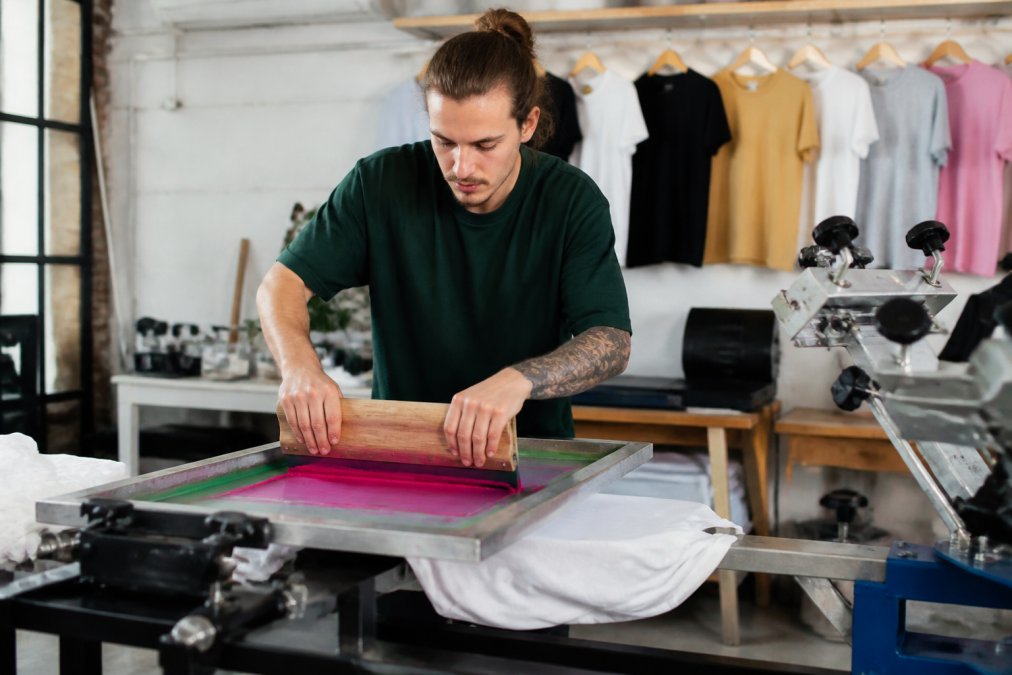
The best t-shirts for screen printing share three traits: a tight weave, consistent fabric weight, and a smooth print surface. Screen printing pushes thick ink through a mesh stencil, so the fabric must hold it without bleeding or stretching.
Look for these features when you're comparing blanks:
- Side-seamed construction keeps the shirt from twisting after washing, which protects your print placement.
- A tear-away label lets you rebrand without a seam ripper and a headache.
- Pre-shrunk fabric reduces the chance your carefully placed design shifts up or sideways.
- Combed or ring-spun cotton gives ink a smoother surface than rougher carded cotton.
- A consistent yarn count across dye lots matters more than most buyers realize; blanks from the same mill vary lot to lot, causing uneven ink laydown on multi-color runs.
Ink Adhesion and Color Vibrancy
Most guides tell you to "test your blank" and stop there. The useful question is why some fabrics hold ink better, because that tells you what to look for before you pull a squeegee.
Ink adhesion comes down to three physical factors:
- Surface energy of the fiber. Cotton is hydrophilic, so water-based and discharge inks bond well. Polyester is hydrophobic and slick, so plastisol and DTG inks need a low-cure or poly-specific formulation. On a 50/50 poly-cotton, cotton takes ink while poly resists it, causing the mottled look on blends.
- Weave tightness and fiber ends. A tight, combed, ring-spun surface gives the ink film a dense field of fiber ends to anchor to. A loose, carded weave has gaps the ink sinks into, so the printed layer sits unevenly and fine lines feather.
- Cure temperature and dwell. Ink that is under-cured never fully crosslinks, so it lifts and cracks. Ink that is over-cured scorches and yellows, especially on light blanks. A heat gun and a temperature strip are more reliable than eyeballing it.
Fabric blend changes the outcome in predictable ways:
- 100% ring-spun cotton: best all-around ink reception; plastisol, water-based, and discharge all behave well.
- Combed cotton: smoothest surface, sharpest fine-line and halftone detail, but slightly less ink pickup than ring-spun.
- Poly-cotton (50/50): low shrinkage and good durability, but DTG ink bonds less evenly and discharge printing will not work because discharge only removes cotton dye.
- Tri-blend (cotton/poly/rayon): beautiful drape and vintage hand, but the rayon content absorbs ink at a different rate than the cotton, so opacity varies across the print.
Ring-Spun vs Combed Cotton for Printing
Ring-spun and combed cotton start from the same raw fiber, but processing differs. Ring-spun cotton is twisted tightly during spinning, creating a stronger, softer yarn. Combed cotton has shorter fibers removed before spinning, leaving a smoother, finer thread.
- Ring-spun: softer hand feel, holds shape longer, great for screen printing.
- Combed: extremely smooth, ideal for detailed DTG work, slightly less durable.
- Carded: rougher and cheaper, best for basic promo tees where softness is not the priority.
Print Surface and Softness
Print surface is the flatness and tightness of the fabric where ink lands. A smoother surface means cleaner edges, sharper lines, and less ink wasted filling gaps in a loose weave.
Best Fabric Weight for Graphic Tees
The best fabric weight for graphic tees is 4.5 to 5.5 oz per square yard for year-round wear, with heavier options for structured, premium merchandise. Weight decides how the shirt drapes, how opaque it is, and how well it holds a print.
- Under 4.5 oz: light and breathable, best for warm-weather and fitted fashion tees.
- 4.5 to 5.5 oz: the everyday sweet spot for custom apparel and merchandise.
- Over 5.5 oz: structured and durable, best for premium or workwear-style prints.
GSM and Opacity
GSM (grams per square meter) is the metric measure of fabric weight and directly affects opacity. Higher GSM means a denser fabric that blocks light and hides what's underneath, crucial when printing light ink on a dark shirt.
Durability and Wash Testing: Shrinkage and Neckline Retention
Durability comes down to two things buyers notice first: shrinkage and neckline retention. A shirt that shrinks two sizes or develops a wavy collar gets returned, no matter how good the print looked on day one.
A 20-Cycle Wash Test You Can Actually Run
You do not need a lab. You need a tape measure, a permanent marker, and patience.
- Mark your baseline. Lay the shirt flat and measure body length (high point of shoulder to hem), chest width (1 inch below each armhole), and sleeve length. Write the numbers on a tag and pin it to the shirt.
- Wash warm, tumble dry medium. This is harsher than most customers will treat a shirt, which is the point, you want to see the worst case, not the best.
- Measure at cycles 1, 5, 10, and 20. Most shrinkage happens in the first one to three cycles on an untreated blank. If a shirt is still losing length at cycle 10, it was never properly pre-shrunk.
- Check the neckline after every cycle. Lay the collar flat and look for ripples, then measure the collar opening across the widest point and compare it to baseline.
What to watch for:
- Body length: a well-made pre-shrunk ring-spun cotton blank typically settles within 2-3% of its original length. Untreated carded cotton can move 5-7% or more, on a 29-inch body, close to two inches, enough to shift a chest print toward the collar.
- Chest width: width shrinkage is usually smaller than length shrinkage, but a blank that narrows more than about 3% will start to feel tight across the shoulders.
- Neckline: this is where cheap blanks give themselves away. Measure the collar opening at baseline and again at cycle 20. A collar that grows more than roughly a quarter inch has lost its recovery.
Why Necklines Fail (and How to Spot a Good One Before You Buy)
A neckline fails because of how the collar is built, not because the fabric is bad.
- Single-needle sewn collars are the weak point. The ribbing is attached with one row of stitching and no taping, so nothing resists the pull of the shirt body. These ripple after a handful of washes.
- Double-needle sewn collars add a second stitch line, which roughly doubles the seam's resistance to stretch. This is the minimum you should accept for anything you plan to sell.
- Shoulder-to-shoulder taping runs a strip of fabric tape across the back of the neck, connecting both shoulder seams. It stops the collar from being dragged out of shape by the weight of the shirt and is one of the clearest markers of a blank built to last.
- Collar rib content matters too. A collar with more spandex or elastane recovers its shape better than a 100% cotton rib, which stretches and stays stretched.
Print-on-Demand vs Bulk Wholesale Sourcing for Plain Tees
Choosing between print-on-demand and bulk wholesale changes your cash flow, margins, and risk. Print-on-demand prints each order as it comes in, so you hold no inventory. Bulk wholesale means buying blanks up front at a lower per-unit cost, then printing and storing them yourself.
Here's how the two compare for a small maker:
| Factor | Print-on-Demand | Bulk Wholesale |
|---|---|---|
| Upfront cost | Low, pay per order | Higher, buy in volume |
| Per-unit cost | Higher | Lower |
| Inventory risk | None | You hold the stock |
| Print control | Limited to partner methods | Full control over ink and technique |
| Best for | Testing designs, no capital | Proven sellers, scaling a brand |
Conclusion: Choosing Your Blank Canvas
The best plain tees for graphic design match your printing method, design detail, and customer expectations. Get the fabric type, weight, and construction right, and your prints stay sharp through every wash.
Frequently Asked Questions
What are the best t-shirts for graphic designers to use for printing?
The best plain tees for graphic design are ring-spun cotton or poly-cotton blends with a weight between 4.5 and 6.5 oz. Ring-spun cotton offers a smooth print surface for fine details, while poly-cotton blends resist shrinkage and hold color well. Look for side-seamed construction and a tear-away label so the shirt stays comfortable and flat after printing.
Which fabric weight is best for custom graphic tees?
For most custom graphic tees, a midweight fabric around 5.0 to 5.5 oz (roughly 170 to 190 GSM) works best. It is heavy enough to prevent show-through and holds screen-printed ink without bleeding, yet stays breathable for everyday wear. Lightweight tees under 4.0 oz can feel flimsy and may not support bold prints, while heavyweight options above 6.5 oz feel stiffer and take longer to break in.
What is the difference between ring-spun and carded cotton for printing?
Ring-spun cotton is combed and twisted tightly, creating a smoother, softer fabric with fewer stray fibers, which gives screen-printed and DTG designs cleaner edges. Carded cotton is rougher and less expensive, so prints can look slightly fuzzy on fine details. For high-quality graphic tees, ring-spun or combed cotton is usually worth the small extra cost.
Are heavyweight or lightweight tees better for graphic design?
Heavyweight tees (6.0 oz and up) are better for structured, oversized silhouettes and bold screen prints because they resist stretching and hold shape through repeated washes. Lightweight tees (under 4.5 oz) suit vintage-wash looks and all-over DTG prints where a soft drape matters more than opacity. Many designers keep both weights on hand and match them to the artwork and target customer.