 how-to
7 Steps to Choose High Quality Fabric Panels
Quick Summary
To choose high-quality fabric panels, check that the fiber is 100% cotton or premium quilting cotton, that the fabric feels smooth and substantial, and that the print is crisp with even color. Then measure the panel, prewash it, and test colorfastness before cutting.
- Look for "100% cotton" or "premium quilting cotton" on the label or product description.
- Hold the panel to light to check for an even, tight weave with no thin spots or gaps.
- Rub a damp white cloth over the print to check colorfastness before you cut.
- Measure the panel and sketch your layout, subtracting border widths from the design area.
- Prewash in cold water on a gentle cycle, since cotton can shrink and dyes may bleed.
Table of Contents
- What Makes a Fabric Panel High Quality
- Step 1: Check the Fiber Content and Weight
- Step 2: Inspect Print Clarity and Color Accuracy
- Step 3: Measure the Panel and Plan Your Layout
- Step 4: Evaluate Panel Themes and Pair Complementary Fabrics
- Step 5: Prewash and Test Before You Cut
- Buying Fabric Panels Online: What to Check Before You Order
- Start Your Next Quilt With the Right Panel
- Frequently Asked Questions
What Makes a Fabric Panel High Quality
Last Updated: November 8, 2026
Teecraftsmarket carries printed fabric panels for quilters, garment sewists and home crafters, and a good panel can make or break a project. Teecraftsmarket's panels are printed in the United States on premium 100% quilting cotton. Knowing what separates a high-quality panel from a weak one saves money and frustration.
A fabric panel is a pre-printed piece of fabric, usually sold in a set size, with a design already printed on it. Quality comes down to four things: the fiber, the weight, the print, and how the panel behaves after washing.
Here's what to look for:
- Fiber content: 100% cotton is the standard for quilting
- Weight and feel: Medium weight, firm but not stiff
- Print sharpness: Clean edges and even color across the panel
- Consistent size: Panel dimensions that match the listing
We recommend checking each of these before you commit to a project.
Step 1: Check the Fiber Content and Weight
Start with the label or product description. Look for "100% cotton" or "premium quilting cotton." Blends can work for some projects, but they often behave differently when pressed, washed, or stitched.
Feel the fabric. Quilting cottons should feel smooth and substantial, not thin or papery. A lightweight panel may wrinkle easily and shift under the presser foot.
Watch out: A panel that feels slick or stretchy is often a blend or a poor-quality print base. Check the fiber content before you cut.
Step 2: Inspect Print Clarity and Color Accuracy
Hold the panel up to natural light and run through a short inspection checklist. A few minutes of close looking can catch problems before you cut.
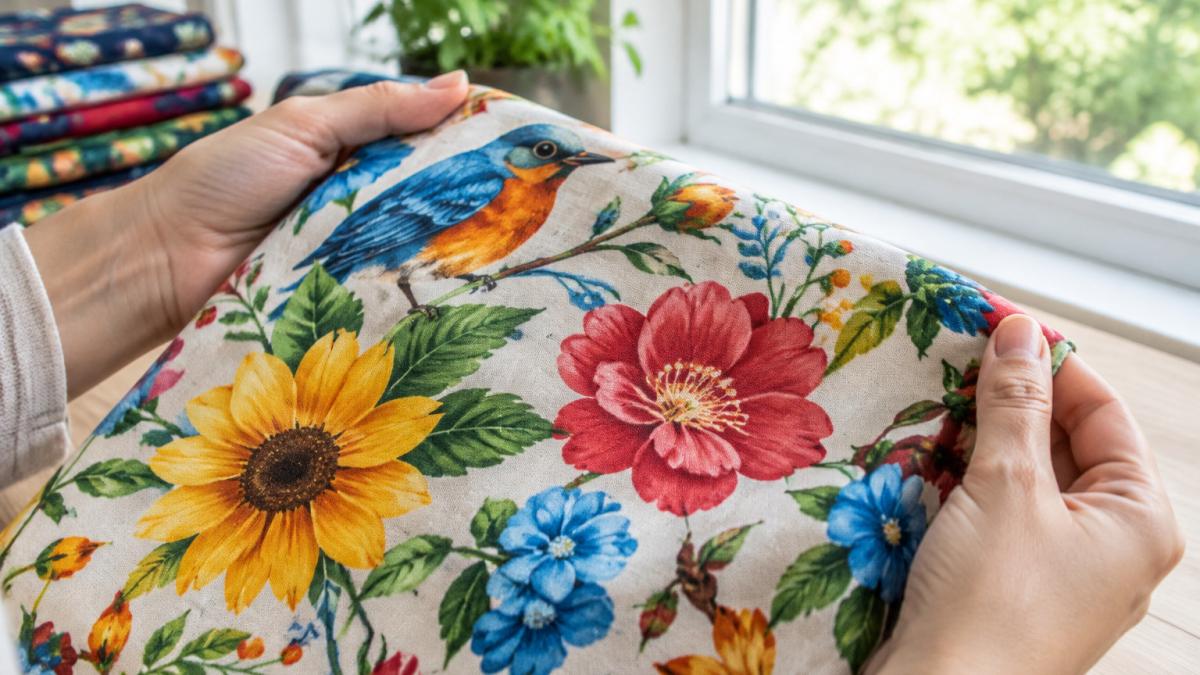
- Print clarity: Look for crisp outlines and clean edges on the smallest motifs. Blurry edges, halos around shapes, or visible dot patterns at normal viewing distance usually mean a low-resolution print process or a loose weave that lets ink spread.
- Color evenness: Scan the full panel for streaking, banding, or patchy areas where the ink looks lighter or darker. Compare the same color across the panel, a floral red in one corner should match the red in another.
- Weave consistency: Hold the panel against a window or bright lamp. You should see an even, tight grid of threads with no thin spots, slubs, or visible gaps. An uneven weave can pucker when quilted and may print unevenly.
- Fabric hand: Rub the panel between your fingers. Quality quilting cotton feels smooth and substantial, not papery, slick, or stretchy. A slick or stretchy hand often signals a blend or a poor print base.
- Colorfastness: Rub a damp white cloth over a printed area, especially a dark or saturated color. If color transfers to the cloth, the dye may not be stable and could bleed in the wash.
- Shrinkage: Check the product listing for a shrinkage note or prewash recommendation. If none is given, assume the cotton may shrink and plan to prewash before cutting.
Keep in mind that screens show colors differently than printed cotton. Browser settings, monitor calibration, and even the room lighting can shift tones, so the fabric in hand may look slightly different from the product photo. Treat the photo as a guide, not a guarantee, and ask the shop whether it notes color variation between screens and printed fabric.
Watch out: A panel that looks crisp on screen but shows blurry edges, thin spots, or a slick hand in person may be a weak print base, so check it before you cut.
The article's inspection checklist breaks down what to check on a panel before cutting.
| Check | What to look for | Warning sign |
|---|---|---|
| Print clarity | Crisp outlines and clean edges | Blurry edges, halos, visible dot patterns |
| Color evenness | Same color matches across the panel | Streaking, banding, patchy areas |
| Weave consistency | Even, tight grid of threads | Thin spots, slubs, visible gaps |
| Fabric hand | Smooth and substantial | Papery, slick, or stretchy feel |
| Colorfastness | No color transfer to a damp white cloth | Color transfers to the cloth |
| Shrinkage | Listing note or prewash recommendation | No note given, so assume shrinkage |
Step 3: Measure the Panel and Plan Your Layout
Measure the panel before you buy. Panel sizes vary, and a design that looks large in a photo may be smaller than you expect. Write down the width and length, then sketch how many blocks, borders, or cuts you can get from it.
Plan for seam allowance. If you're adding borders or sashing, subtract the width of each border from your total design area. Measuring first prevents running short on a project.
Step 4: Evaluate Panel Themes and Pair Complementary Fabrics
Choose a theme that fits the project. Floral, wildlife, scenic, seasonal, and children's prints each suit different uses. A baby-themed panel works well for a nursery quilt, while a seasonal print fits a wall hanging.
When you pair panels with other fabrics, look at color and scale. Match one or two colors from the panel and vary the print size. Large prints work best with small, simple fabrics, and solids help the panel stand out.
Browse the options here: Woodland Baby Bunny 3 Fabric Panel shows how a finished panel design looks and scales. For a comparable baby-themed print, see the Baby Boy Elephant Fabric Panel 3 to see how motifs work on fabric. To see how strong motifs pair alongside other prints, check the Quilted Toy Animals Fabric Panel 6.


Step 5: Prewash and Test Before You Cut
Prewash panels before cutting, since cotton can shrink and some dyes may bleed. Wash in cold water on a gentle cycle, then dry on low or hang to dry.
Test colorfastness on a scrap first. Rub a damp white cloth over the print. If color transfers, the dye may not be stable. Avoid bleach, and do not iron the panel while it is still wet.
Common mistake: Skipping the prewash step can lead to puckering or uneven shrinkage after the quilt is finished.
Buying Fabric Panels Online: What to Check Before You Order
Online shopping makes it hard to judge texture and color, so treat each listing as a set of claims to verify. A common pattern is to run through the same checklist on every listing before you add a panel to the cart.
- Scale: Look for a ruler, coin, or hand in the product photo, or a stated motif size. A design that looks large in a thumbnail may be much smaller on fabric. If the listing gives no scale reference, ask the shop for the printed area dimensions.
- Color accuracy: Read any note about color variation between screens and printed fabric. Compare the listing photo against the shop's other photos of the same panel, inconsistent tones across images are a warning sign.
- Dimensions: Confirm the finished panel size, not just the cut size. Listings sometimes quote the fabric cut rather than the printed area, and selvages or unprinted margins can shrink the usable design.
- Fiber content: Look for a specific fiber callout such as '100% cotton' or 'premium quilting cotton.' A vague 'cotton blend' or no fiber note at all is a reason to ask before ordering.
- Return policy: Check whether the shop accepts returns on cut fabric and what condition is required. Cut yardage is often final sale, so confirm the policy before you commit to a full set of panels.
- Shipping and handling: Note whether panels ship folded or rolled. Sharp folds can set creases that are hard to press out of a printed design.
If you are buying several panels for one project, order one first to check quality, color, and scale before buying the full set. That single-panel test is cheaper than discovering a mismatch after you have cut into a coordinated bundle.
Watch out: A listing that shows a beautiful panel but gives no printed-area dimensions, no fiber content, and no return policy is a gamble, ask the shop for those details in writing before you order.
Start Your Next Quilt With the Right Panel
A good panel gives you a strong starting point for quilts, wall hangings, and garment projects. Check the fiber, inspect the print, measure carefully, and prewash before cutting. For a next purchase, consider the 6 Bible Verse Fabric Panel, a distinct themed option for a new project.
Ready to start? Explore the full collection at Teecraftsmarket and find the right panel for your next project.
Frequently Asked Questions
How can you tell if a fabric panel is good quality?
Look at four things: fiber content, weight, print sharpness and the backing. A good quilting panel is 100% cotton with a tight, even weave that feels substantial rather than thin. Check that the print is sharp on both sides, with no fuzzy edges, streaks or misaligned repeats. Pull a small corner to see whether the threads hold. If the listing does not state the fiber content, treat that as a warning sign and look for a seller who lists it clearly.
What fabric is best for quilt panels?
Most quilters choose 100% cotton quilting fabric for preprinted quilt panels because it sews smoothly, presses well and holds color through repeated washing. Cotton also takes fine printed detail without bleeding. Blends and synthetics such as polyester can be harder to press and may not match the look of traditional quilt blocks. For stretch apparel panels, a poly-spandex blend is the better choice, so match the fiber to the project.
Should you prewash a fabric panel before quilting?
Prewash cotton panels before you cut them, especially if the quilt will be washed often or sewn alongside other fabrics. Prewashing removes excess dye and reveals any shrinkage, so your finished blocks stay the size you planned. Wash in cold water on a gentle cycle, dry on low or hang to dry, and press before measuring. Test a small swatch first if you are unsure about colorfastness. Synthetic stretch panels usually need gentler care, such as cold water on a delicate cycle with no bleach and no ironing.
What should beginners look for when buying fabric panels?
Beginners should start with a panel made from 100% cotton, a clear print and a size that matches their project. Choose a panel with a simple layout that is easy to cut around, and check the listing for dimensions so you know how much usable print you will get. Avoid very dense or high-contrast designs until you are comfortable lining up seams and borders. A panel with a solid border or clearly marked cutting lines makes the first project easier to plan.