 how-to
Bulk Craft Supplies for Small Businesses: A Sourcing Guide
Table of Contents
- Understanding Bulk Craft Supplies for Small Businesses
- Where to Buy Craft Supplies in Bulk
- How to Calculate Wholesale Supply Costs
- Finding Bulk Craft Supplies with Low Minimum Order Requirements
- Craft Supply Inventory Management for Makers
- Vetting Suppliers and Ordering Samples
- Common Sourcing Mistakes to Avoid
- Frequently Asked Questions
Last Updated: October 5, 2026
Understanding Bulk Craft Supplies for Small Businesses
Sourcing bulk craft supplies for small businesses is fundamentally about controlling costs while maintaining quality. When you're making handmade products to sell, every dollar spent on materials directly impacts your profit margin. That's why understanding how to buy craft supplies in bulk matters so much for makers who want to scale.
Bulk craft supplies for small businesses differ from retail purchases in one critical way: volume discounts. When you commit to larger quantities, suppliers offer lower per-unit costs. A beading kit that costs $15 retail might cost $8 when you buy ten at once. For a maker producing 50 necklaces a month, that difference compounds quickly.

The challenge isn't finding bulk options. It's finding the right suppliers for your specific craft, understanding the real cost of buying in bulk, and managing inventory so you don't tie up cash in supplies that sit unused. This guide walks through the entire sourcing process, from identifying suppliers to calculating true costs to avoiding common mistakes that drain small business budgets.
Where to Buy Craft Supplies in Bulk
Your sourcing options break into three categories: direct wholesalers, craft retailers with bulk programs, and online suppliers that sell to makers.
Direct wholesalers typically require business registration and minimum order quantities. They sell at the lowest prices because they skip the retail markup. Many require a resale certificate or business license before you can order.
Craft retailers with bulk options include established names that sell to both hobbyists and small business owners. These suppliers usually have lower minimums than direct wholesalers and don't always require proof of business status. You might find bulk pricing at 10-unit minimums instead of 100-unit minimums. The trade-off is slightly higher per-unit costs than true wholesalers.
Online suppliers and marketplaces have expanded dramatically. Many small makers now source through platforms that cater specifically to craft businesses. These options often feature flexible ordering, transparent pricing, and the ability to order samples before committing to bulk quantities.
At Teecraftsmarket, our curated selection includes items like our 800pcs Faux Pearl Beading Kit at $15.52, or the 14400pcs Assorted Polymer Clay Beads Kit at $36.03.

How to Calculate Wholesale Supply Costs
Most makers stop at the sticker price and call it their cost. That's the fastest way to misprice a product.
Here's the worksheet. Build it once in a spreadsheet and reuse it for every supplier quote.
Step 1, Gather the raw inputs.
- Product subtotal (the quoted bulk price)
- Inbound shipping and freight
- Sales tax or any duty/fee the seller passes through
- MOQ (minimum order quantity), the units you're forced to buy, not the units you want
- Packaging you add (bags, tags, boxes, labels)
- Expected defect/waste rate (the share of units you'll discard)
Step 2, Compute landed cost per unit.
Landed cost per unit = (Subtotal + Shipping + Tax + Packaging) ÷ (Units received × (1 − Waste rate))
Step 3, Worked example.
You order 1,000 beads at $0.05 each = $50. Shipping is $18. Tax is $4. You add $0.02 of packaging per finished piece. You expect 5% waste from defects and breakage.
- Total spend: $50 + $18 + $4 = $72
- Usable units: 1,000 × 0.95 = 950
- Landed cost per usable bead: $72 ÷ 950 = $0.0758
- Add packaging: $0.0758 + $0.02 = $0.0958 per finished piece
That's nearly double the $0.05 sticker price. If you priced your product off $0.05, you undercharged by almost 100% on materials.
Step 4, Compare against your selling price.
A common target for handmade goods is keeping materials at 20-30% of the retail price. If your landed cost per piece is $0.0958 and you sell for $12, materials are 0.8% of revenue, very healthy.
Step 5, Test MOQ breakpoints.
Suppliers often tier pricing: 100 units at $0.06, 500 at $0.05, 1,000 at $0.045. Run the worksheet at each tier. Sometimes the bigger order wins on unit cost but loses on cash flow if you can't sell through it in a reasonable window.
Finding Bulk Craft Supplies with Low Minimum Order Requirements
Not every maker can commit to 500-unit minimums. Low-minimum suppliers exist, but you need to know where to look.
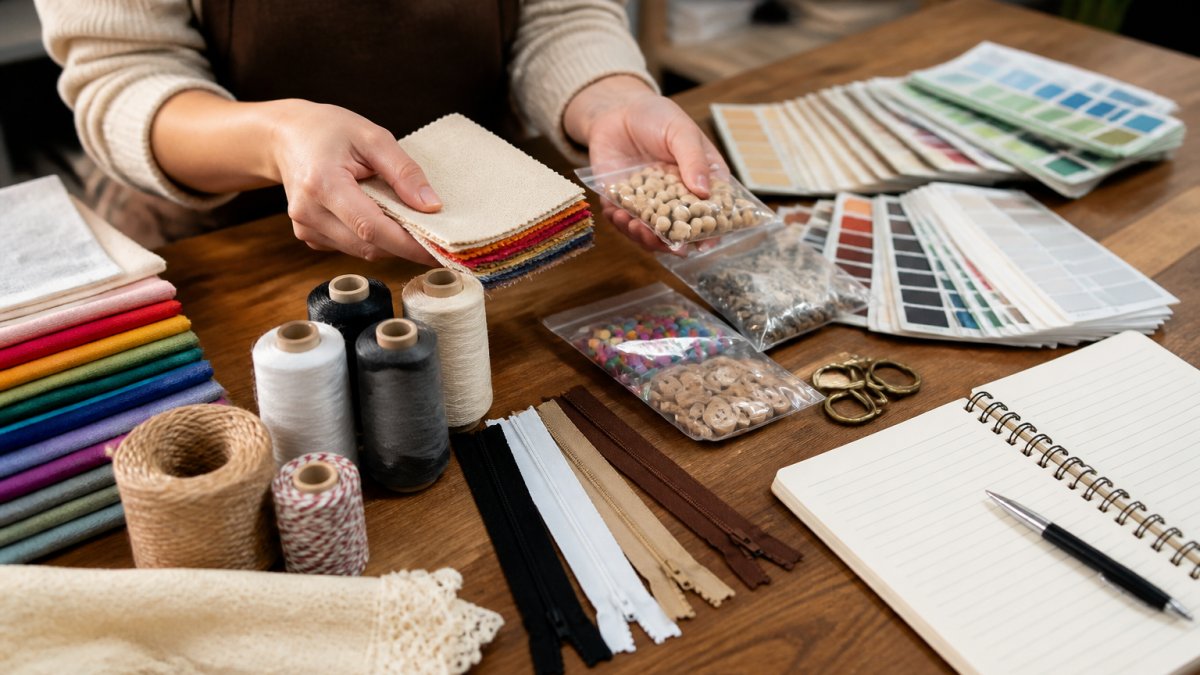
Many online craft suppliers now offer bulk pricing at 10, 25, or 50-unit minimums instead of requiring 100+ orders. These platforms recognize that small makers need flexibility. You pay slightly more per unit than true wholesalers, but you avoid overstock risk.
Supplier minimums vary wildly by product category. Beads and findings often have low minimums. Fabric panels might require larger orders. Specialty items like fill-able ornaments or deco mesh may have different thresholds depending on the supplier.
The key is asking directly. Don't assume a supplier won't work with your order size. Many wholesalers will negotiate minimums for consistent buyers or for orders that hit a certain dollar threshold instead of a unit count. A $300 order might qualify for bulk pricing even if it's only 50 units.
Look for suppliers that clearly advertise bulk options for small businesses. These companies understand your constraints and have pricing structures built for makers scaling gradually, not manufacturers buying pallets.
Craft Supply Inventory Management for Makers
Buying bulk craft supplies for small businesses only works if you manage inventory well.
The biggest mistake is buying everything at once. New makers often purchase massive quantities of their favorite materials, then discover three months in that they've used 20% of it.
800pcs/box Faux Pearl Beading Kit For DIY Jewelry Making Loose Spacer Beads →
Instead, use a rolling inventory system. Order enough to cover 4-6 weeks of production. Track what you actually use. After two or three cycles, you'll see patterns. Certain beads sell faster than others. Some materials go unused.
Organize supplies by product category and reorder point. When inventory drops to your minimum level, place the next order. This prevents both stockouts and overstock. A simple spreadsheet works fine, list each material, current quantity, reorder point, and last order date.
Storage matters more than makers realize. Beads, findings, and paper supplies need dry conditions. Humidity damages some materials. Temperature swings can affect adhesives and certain fabrics. Organize your storage area so you can actually find things.
Consider the cash-flow impact. If you spend $2,000 on supplies but only generate $800 in sales that month, you've created a cash problem. Buy strategically. Front-load orders for your best-selling products. Be conservative with experimental materials until you confirm demand.
Vetting Suppliers and Ordering Samples
A supplier that looks great on a product page can still wreck your business through inconsistent quality, missed lead times, or a return policy that leaves you holding defective stock. Vet before you commit to a bulk order, not after.
Run a sample order first, every time.
Order the smallest quantity the supplier allows, even if it costs more per unit. A $20-$50 sample is cheap insurance against a $500 mistake. When the sample arrives, evaluate it against a written checklist so you're comparing apples to apples across suppliers:
- Dimensional accuracy, measure a random sample of 10-20 pieces. Do they match the listed size within a reasonable tolerance?
- Color consistency, lay pieces side by side under the same light. Are there dye-lot variations within the same bag?
- Material integrity, flex, tug, and stress-test a few pieces. Do beads crack, does fabric fray, does adhesive release?
- Finish quality, check for burrs, sharp edges, uneven coating, or print misregistration.
- Packaging condition, did anything arrive crushed, damp, or mixed with the wrong SKU?
Ask these questions before ordering in bulk:
- What is your defect rate, and how do you handle a batch that arrives out of spec?
- What is your return or replacement window, and who pays return shipping?
- What is your typical lead time from order to delivery, and how often do you miss it?
- Is the SKU I sampled the same SKU I'll receive in bulk, or is bulk pulled from a different production run?
- Do you notify buyers when a dye lot or formulation changes?
A supplier who can't answer these clearly is a supplier who will surprise you later.
Understand resale documentation requirements.
Many true wholesalers won't sell to you without proof you're buying for resale. In the U.S., that usually means one or both of:
- A state-issued resale certificate (sometimes called a seller's permit or sales tax permit), which lets you buy inventory without paying sales tax that you'd otherwise collect when you resell.
- A business license or EIN, which some suppliers ask for as basic verification.
Requirements vary by state and by supplier. Some wholesalers accept a simple business registration; others insist on a resale certificate tied to the state where you operate.
Test stock reliability before you depend on it.
Place two small orders a few weeks apart and compare. If the second order arrives with a different shade, a thinner gauge, or a longer lead time, that's your signal the supplier can't hold consistency at scale.
Build the relationship deliberately.
Once you've found a supplier that passes the checklist, order on a predictable schedule and communicate clearly about volume. Suppliers reward reliable buyers with better pricing tiers, priority on out-of-stock items, and early notice of discontinuations, all of which protect your production schedule.
Common Sourcing Mistakes to Avoid
The most expensive mistake is buying bulk craft supplies for small businesses without understanding your actual production needs.
New makers often purchase based on what's available or what's trendy, not what they'll actually use. You see an amazing assortment of 12 colors of seed beads and buy all of them.
Another common error is ignoring shipping costs in your pricing. A supplier offers beads at $4 per unit. You calculate your product price based on that.
Makers also underestimate storage and handling costs. Bulk supplies require space. If you're renting extra storage or paying for climate control, those costs affect profitability.
Switching suppliers too frequently creates waste. You find a new source with slightly lower prices and reorder from them instead of your established supplier.
Finally, many small makers don't track their actual material costs. They guess at what they spent. Without real numbers, you can't calculate true profit margins or make smart reordering decisions.
Sourcing bulk craft supplies for small businesses requires strategy, not just finding the cheapest option. Our curated craft supplies, from glass seed bead sets to scrapbook bundles, are chosen for quality and practical utility.

Frequently Asked Questions
Where can I buy bulk craft supplies for my small business?
Bulk craft supplies are available from wholesale distributors, direct manufacturers, and curated retailers. Wholesale craft suppliers typically offer tiered pricing based on order quantity, while direct manufacturers may require larger minimum orders but offer lower per-unit costs. Retailers like Teecraftsmarket provide curated selections of quality supplies in various quantities, allowing small makers to start with smaller orders and scale up. Compare minimum order requirements, shipping costs, and product quality before committing to a supplier.
How do I calculate the cost of bulk craft supplies per finished product?
To calculate per-unit cost, divide the total cost of your bulk order (including shipping) by the number of usable pieces. For example, if a bulk bead kit costs $36.03 and contains 14,400 pieces, your cost per bead is roughly $0.0025. Account for waste or defects by reducing your usable quantity by 5-10%. Then add labor, packaging, and overhead to determine your true production cost and profit margin for each finished item.
What minimum order quantities should I expect when buying bulk craft supplies?
Minimum orders vary widely by supplier and product type. Many wholesalers require orders of 50-500 units, while some specialty suppliers accept smaller quantities starting at 10-25 pieces. Retailers focused on small makers often have no minimum or very low minimums, making them ideal for testing products before committing to larger wholesale orders. Always confirm minimum order requirements before approaching a supplier.
How much inventory should I keep on hand as a small craft business?
Inventory levels depend on your production rate, storage space, and cash flow. A practical starting point is 3-6 months of projected supply needs based on your average monthly sales. Track which supplies sell fastest and reorder those more frequently, while slower-moving items can be ordered less often. Use a simple spreadsheet to monitor stock levels and set reorder points to avoid both stockouts and overstocking, which ties up cash and wastes storage space.