 ultimate-guide
Why Buy USA Made Craft Supplies? A Maker's Guide
Last Updated: November 2, 2026
Quick Summary
Buying USA made craft supplies gives you traceable materials, verifiable working conditions, and specs you can inspect before you cut. Domestic purchases keep more value with the people who made the goods, and listings usually state fiber content, weight, and ship times. Expect a higher up-front price that pays off on repeat production runs.
- The FTC Made in USA standard requires all or virtually all significant parts and processing to be domestic.
- Phrases like designed in USA or USA-owned are not manufacturing claims at all.
- Ask sellers to name the mill or supplier behind the base material before ordering.
- Fabric listings should state fiber content, weight in ounces per square yard, and width.
- For repeat production runs, domestic supplies win because the spec sheet holds batch to batch.
Table of Contents
- Why Buy USA Made Craft Supplies? The Case for Domestic Sourcing
- How Buying American-Made Craft Supplies Keeps Money in Local Communities
- Made in USA Labeling Requirements: What the Label Actually Means
- How to Find USA-Made Craft Supplies Without Getting Burned
- American-Made Fabric and Sewing Supplies: What to Look For
- Price vs. Value: Why Domestic Supplies Cost More and When It Pays Off
- Start Your Next Project with Supplies You Can Trace
- Frequently Asked Questions
Why Buy USA Made Craft Supplies? The Case for Domestic Sourcing
The answer comes down to traceability, working conditions, and materials you can inspect before you cut. When you buy USA made craft supplies, you are buying a product whose origin can be checked rather than assumed.
Domestic sourcing means buying materials and finished goods produced within the country where they will be used, rather than importing them through layers of distributors. For crafters, that shows up in three places: how fast you can reorder, how much you can learn about the material, and how much of your money stays near the people who made the thing.
The case is practical, not sentimental. For a deeper companion take on the same topic, read why choose USA made craft supplies. Materials you can inspect before you cut help you avoid surprises, especially with fabric, where a swapped blend changes how a panel drapes, takes dye, or holds a seam.
Below, we walk through what the label actually means, how to verify it, and when paying more makes sense for your project.
How Buying American-Made Craft Supplies Keeps Money in Local Communities
Most articles stop at "spending locally keeps money local." That is true but not useful when you are choosing between two bolts of fabric. The practical argument is about where the value in a craft purchase lands, and how much stays within reach of the maker.
Where the dollar goes in a domestic craft purchase
When you buy from a domestic maker, the price splits across raw material, labor, equipment and facility costs, packaging, shipping, and the seller's margin. In a domestic operation, labor and facility costs go to people and landlords in the same region as the shop. In an import-heavy purchase, those portions are paid overseas, and the domestic share is mostly warehousing, freight, and retail markup.
The difference is not that one purchase "stays here" and the other vanishes. It is that the domestic purchase keeps a larger share of the value with the people who made the thing, and they tend to spend it where they live.
The craft-specific multiplier
That chain is also what makes the supply verifiable. A shop that buys from a named domestic mill can tell you the fiber content and weight because it has the spec sheet; a shop buying through import distributors often cannot. The local economic benefit and the traceability benefit are the same mechanism viewed from two angles.
What you can actually observe
You do not have to take the economic argument on faith. A few things are visible to any buyer:
- Stated processing times. Look for a specific ship time on the listing, not just a generic "fast shipping" claim. Our cutouts are shipped in under 24 hours, or shipping is free.
- Stated specs. Check that the listing gives material thickness, size range and finish before you buy.
Made in USA Labeling Requirements: What the Label Actually Means
The label means what the Federal Trade Commission's Made in USA standard says it means: all or virtually all of the product's significant parts and processing must be of domestic origin. "Virtually all" is doing real work in that sentence. A product assembled here from imported components generally does not qualify for an unqualified claim.
Watch out: a product described as "designed in USA" or "USA-owned" is not making a manufacturing claim at all. Those phrases are about where the company sits, not where the goods were made.
How to Find USA-Made Craft Supplies Without Getting Burned
The reliable method is to ask for the origin of the specific material, not just the brand.
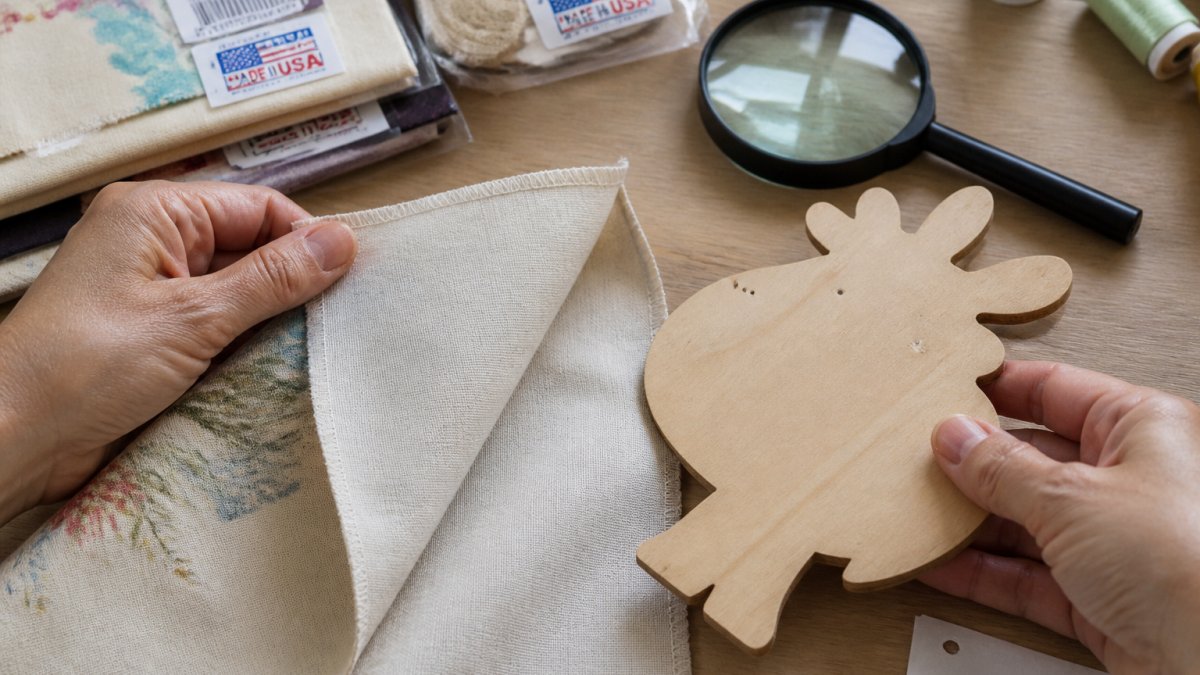
Here is a checklist to use before placing a first order:
- Ask which mill or supplier produced the base material, by name
- Confirm whether the "Made in USA" claim is qualified or unqualified
- Request the material spec sheet for fabric weight, fiber content, and finish
- Check whether the seller lists a physical business address
- Ask what happens if the item arrives damaged
- Look for a stated processing or ship time, not just "fast shipping"
- Search the product name plus "origin" to see if the claim is repeated consistently
A made-in-USA wreath blank is a useful test case: the listing should tell you the thickness and size range. You can shop a made-in-USA wreath blank and read the spec before you buy.
Cabinet Grade Baltic Birch Plywood Dolphin Shape Cutout-made in the USA →
American-Made Fabric and Sewing Supplies: What to Look For
Fabric is where origin claims get softest, because a bolt can be woven in one place, dyed in another, and printed in a third. Ask which of those steps happened domestically before you accept the label.
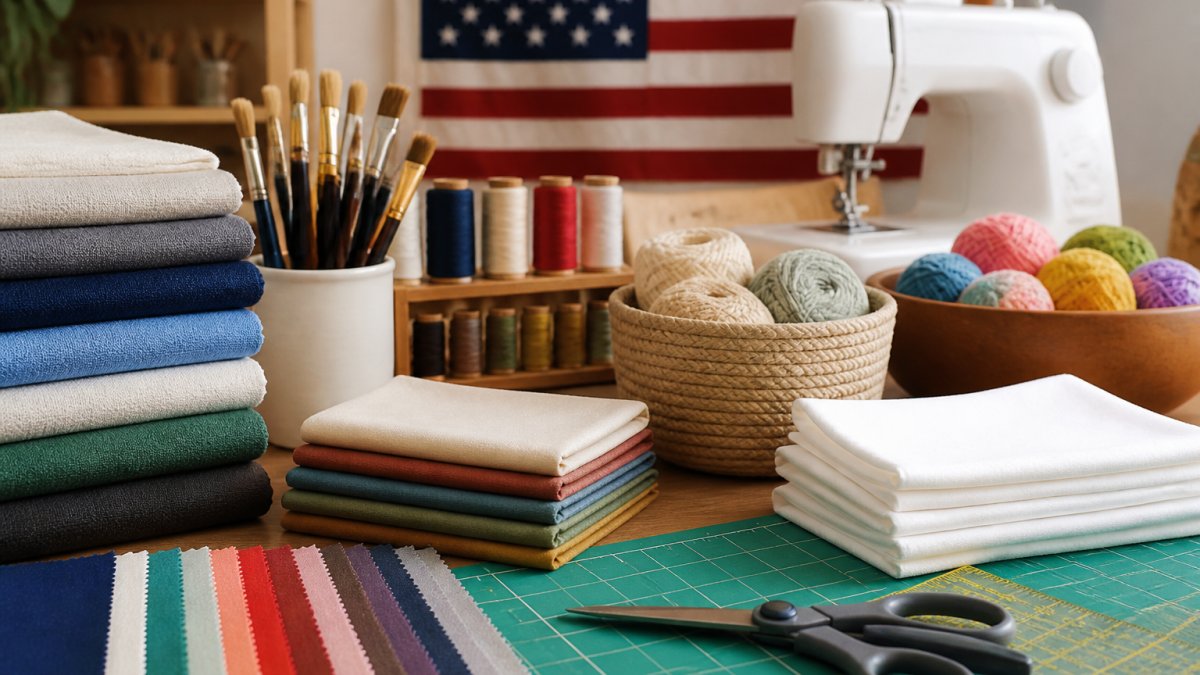
American-made fabric and sewing supplies should give you a fiber content, a weight in ounces per square yard, and a stated width. If a listing skips all three, the origin claim is the least of your problems.
For garment sewing, look for:
- Stated fiber content and whether it is a blend
- Weight class, so you know if it suits a structured garment or a drape
- Shrinkage notes, since untreated domestic cotton behaves differently than pre-shrunk import
- Whether the panel is cut square, which matters more than most makers expect
Price vs. Value: Why Domestic Supplies Cost More and When It Pays Off
Domestic craft supplies usually cost more up front. That is a real trade-off, and the honest way to handle it is to break the extra cost into its parts and decide which parts matter for your project.
Why the up-front price is higher
Several cost drivers can account for the gap between domestic and imported craft supplies:
- Labor. Domestic cutting, printing, sanding, and packing are done by workers paid domestic wages. Import-heavy chains concentrate labor in lower-wage regions, the single largest reason an imported panel or blank is cheaper at the register.
The downstream costs imports hide
The sticker price is not the total cost. Imported craft supplies carry costs that show up later:
A decision framework, not a slogan
The right choice depends on what you are making and how many times you will make it:
| Your situation | What matters most | Which route usually wins |
|---|---|---|
| One-off test project | Lowest entry cost | Import, if the spec is adequate |
| Repeat production run | Batch-to-batch consistency | Domestic, because the spec sheet holds |
| Custom sizing or thickness | Fit and available options | Domestic, where custom sizes are offered |
| Tight deadline | Predictable lead time | Domestic, on short ship times |
| Print-critical design | Inspection and clarity | Domestic, on individually inspected panels |
| Tight budget, non-critical use | Price per unit | Import, with eyes open about variability |
A price-sensitive buyer is not wrong to compare. If you are making one thing for yourself, buy the cheaper option and learn from it. If you are making twenty of something to sell, inconsistent material will cost you more than the price difference, because rework and wasted stock eat the savings.
Availability and shipping realities
That is the practical answer to the price question. Domestic supplies cost more because they carry more information and more consistency. Whether that premium pays off depends on whether your project depends on those two things.
Start Your Next Project with Supplies You Can Trace
At Teecraftsmarket, we carry a curated range of well-made products chosen for practical utility, including fabric panels, art supplies, and sewing equipment. Our listings are proudly printed in the United States of America.
When you are ready to put a traceable material under your hands, start with a piece you can inspect. Our Baltic birch dolphin cutout, Baltic birch cat cutout, and Baltic birch seahorse cutout are each cut from cabinet-grade Baltic birch plywood in 1/8, 1/4, or 1/2 inch thicknesses, with a sanded face and lightly charred edges. Pick a shape, check the spec, and build something you can account for.


Frequently Asked Questions
What are the benefits of buying American-made craft supplies?
The main benefits come down to three things: traceability, quality control, and economic impact. Supplies made domestically fall under US labeling rules, so origin claims are easier to verify. For makers who sell their work, that story is also a selling point customers ask about.
How can I tell whether craft supplies are made in the USA?
Start with the label, then verify it. A Made in USA claim generally means all or virtually all of the product was made domestically, so a vague American quality badge is not the same thing. Look for a named manufacturer, a city or state of production, and a contact address. Ask the seller directly where the material is cut, printed, or assembled.
Are American-made craft supplies better quality than imported ones?
Not automatically, but domestic production often gives you more control over what you receive. That matters most for projects where a flaw ruins the piece, such as quilting, garment sewing, and custom apparel. The practical move is to check specs and reviews rather than assume, then compare a sample before committing to a large order.
Why do USA made craft supplies cost more than imported options?
Domestic production carries higher labor costs, smaller batch sizes, and stricter material sourcing, and those costs show up in the price. Our Baltic birch cutouts are priced from $0.44 to $0.67 depending on the shape. The value question is whether the material holds up through your process.
The hard part of buying domestic is not finding supplies. It is verifying the claim once you have found them, and that takes a seller willing to answer specific questions. Teecraftsmarket stocks a curated range of craft supplies, tees, and tools chosen for real utility, with domestic printing and a listed origin on the products we make. Get started with Teecraftsmarket and put materials you can trace under your next project.